This issue is bigger than the first because a lot moved in one week: rates, oil, a chip company’s CEO and a day of lost email. I’m not an economist. I read the sources, show them, and mark my own opinion as opinion. Reply and tell me what to cover next. — Theodore
See your slow month before it arrives
Cash trouble often shows up as one bad week, not one bad year: a big supplier bill, a slow stretch, a fuel spike you didn’t plan for.
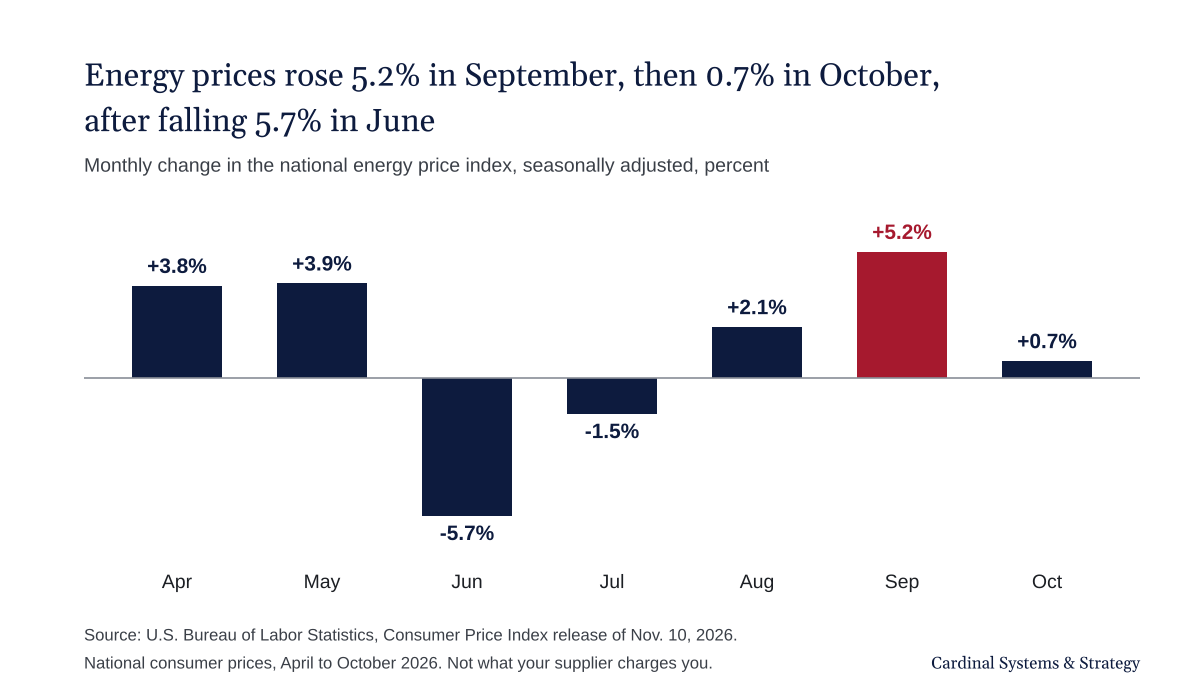
Costs don’t arrive as smooth averages. The national energy price index rose 5.2% in September and 0.7% in October, and gasoline is up 37.4% from a year ago, according to the Bureau of Labor Statistics. Those are consumer prices, not your supplier’s invoice, but the lesson holds: your costs can jump faster than your plan.
A 13-week cash forecast shows the week your balance runs low while you can still act: chase an invoice, move a purchase, or call the bank early. This issue’s free worksheet does the math. Set-up takes about half an hour.
What is a 13-week cash forecast?
It is a week-by-week list of the cash you expect to come in and go out over the next quarter. You put each payment in the week the money actually moves, not the week you booked it. Each week you replace the oldest week with what really happened and add a new one at the end, so you always see 13 weeks ahead.
Why do one-time costs do the most damage?
Because they arrive at full size in a single week. Forecasting guides say not to smooth them into monthly averages: a quarterly tax payment or an annual insurance premium belongs in the week it clears. A trade-show fee, a deposit or a repair works the same way. A budget that spreads them out can look fine while the bank balance does not.
What if the bill lands outside the 13 weeks?
Keep a second list of every big bill expected in the next 12 months, each with its date. When a date falls inside your 13-week window, it drops into that week. That is how a January booth fee and an April travel bill stay on the same radar, even though they sit in different quarters.
What should go on the list?
Start with payroll and payroll taxes, then rent, insurance, loan payments, supplier bills and taxes, including estimated tax payments. Add the irregular items people forget: annual renewals, equipment repairs, trade shows and seasonal inventory. For most individuals and pass-through owners, the fourth-quarter estimated tax payment is due Jan. 15, 2027. Ask your CPA; this is general information, not tax advice.
Add value today: the free 13-week cash worksheet
A free Excel worksheet that turns your next quarter into a weekly cash picture, with a 12-month list for big bills. It takes about half an hour to set up and ten minutes a week to update. No email address needed. Get the free 13-week cash worksheet
From the CSS desk
I once budgeted about $50,000 a year for 30-plus trade shows, from one-person events to huge ones. That covered only the show fees. Rentals, internet and electricity came next, then travel: hotels, meals and mileage for one to five reps. Those bills landed in April for a show paid in January. The real total ran about $50,000 higher. Budgeting from actual data gave me a better forecast, a longer view of costs ahead, and a clear list of shows to cut.
What one regional show really costs (an illustrative example from memory, not an employer or client figure):
| Line | Amount |
|---|---|
| Booth, 10×10 | $1,200 |
| Table and chairs | $280 |
| TV | $400 |
| Internet (up to) | $100 |
| Electricity | $50 |
| Show-side total | $2,030 |
| Hotel, 2 reps × 2 nights × $115 | $460 |
| Meals, 2 reps × 3 days × $35 | $210 |
| Mileage, 200 miles × $0.76 | $152 |
| Travel total | $822 |
| All-in: about 2.4 times the booth fee | about $2,850 |
An illustrative example from memory, with rounded estimates. Not an employer or client figure.
Mileage moves too. The IRS raised the business rate to 76 cents a mile, from 72.5, effective July 1, 2026, citing fuel prices. On a 200-mile trip that is about $7 more; on 6,000 miles a year, about $210. A rate set in January was out of date by July.
A small win: a TV rental at a big Las Vegas show was $750 for three days. We bought one for about $250 and gave it to a local business afterward, saving roughly $500.
The big picture: five numbers behind your next quarter
Prices, rates, jobs, fuel and gold each moved this month. Here is where they stand and what each means for a small shop.
| Number | Where it stands | What it means for you |
|---|---|---|
| Prices | Consumer prices rose 0.4% in October after 0.6% in September. BLS published no annual rate this month, because October 2025 prices were never collected. | Re-check quotes on any job where energy is a real cost. |
| Interest rates | The Fed held at 3.75%–4.00% on Oct. 28, with two members voting to raise. The 10-year Treasury yield was about 4.84% on Nov. 7, down from above 5.3% in early October. | Variable-rate credit lines can reprice. Fixed-rate decisions can wait a few weeks. |
| Jobs | Employers added 165,000 jobs in October, against an average of 48,000 a month over the prior year. Unemployment is 4.1%. Wages are up 3.1% over 12 months. People working part time who want full-time hours rose by 339,000 to 4.8 million. | Hiring stays competitive. Budget for wage pressure. |
| Fuel | National gas averaged $4.10 on Nov. 5, the highest ever for this time of year. Crude, above $100 the week before, was in the high $80s to low $90s. | Put fuel on every job’s cost line. |
| Gold | About 30% below its January record near $5,600, at roughly $4,050 to $4,150 in early November. | Mostly a signal about rates and the dollar, not a cost to you. |
National figures. Sources: BLS, the Federal Reserve, AAA; Treasury yield and gold from market reports (see Sources).
One oddity worth noting: gold usually rises when inflation and war worry investors. This year it fell about 30% from its January record, even as oil spiked. Analysts point to higher interest rates and a stronger dollar, and to investors selling gold to raise cash during the stock sell-off.
| Month (2026) | Change |
|---|---|
| April | +3.8% |
| May | +3.9% |
| June | −5.7% |
| July | −1.5% |
| August | +2.1% |
| September | +5.2% |
| October | +0.7% |
Source: U.S. Bureau of Labor Statistics, Consumer Price Index release of Nov. 10, 2026. National consumer prices, not what your supplier charges you.
The AI question: is the boom a bubble? What the numbers say
Facts below are cited in the Sources list at the end. Opinion is marked as opinion.
What happened on Nov. 5?
Stocks fell sharply after the midterms. The Nasdaq dropped 5.52% and the S&P 500 fell about 4.4%, with reports tying the move to fears that new lawmakers could slow data-center building. One analysis put the Nasdaq about 11.9% below its Oct. 6 record, which it calls a correction, not a burst. One report says markets won back about two-thirds of the drop within two sessions.
Why does one sector matter this much?
Because so much of the market and the economy now leans on it. Bloomberg found that more than half of the roughly $32 trillion added to the S&P 500 since ChatGPT launched came from ten AI-linked companies. ING estimates AI-related investment accounts for about a third of 2026 U.S. growth, though published estimates range widely depending on definitions.
What is the bear case?
Much of the money is circular and borrowed. Chipmakers invest in the companies that buy their chips, and data-center projects have been financed with large amounts of debt, including junk bonds. The biggest AI developers do not yet earn consistent profits. If revenue arrives later than the spending, lenders feel it first, and higher interest rates make that harder.
What is the bull case?
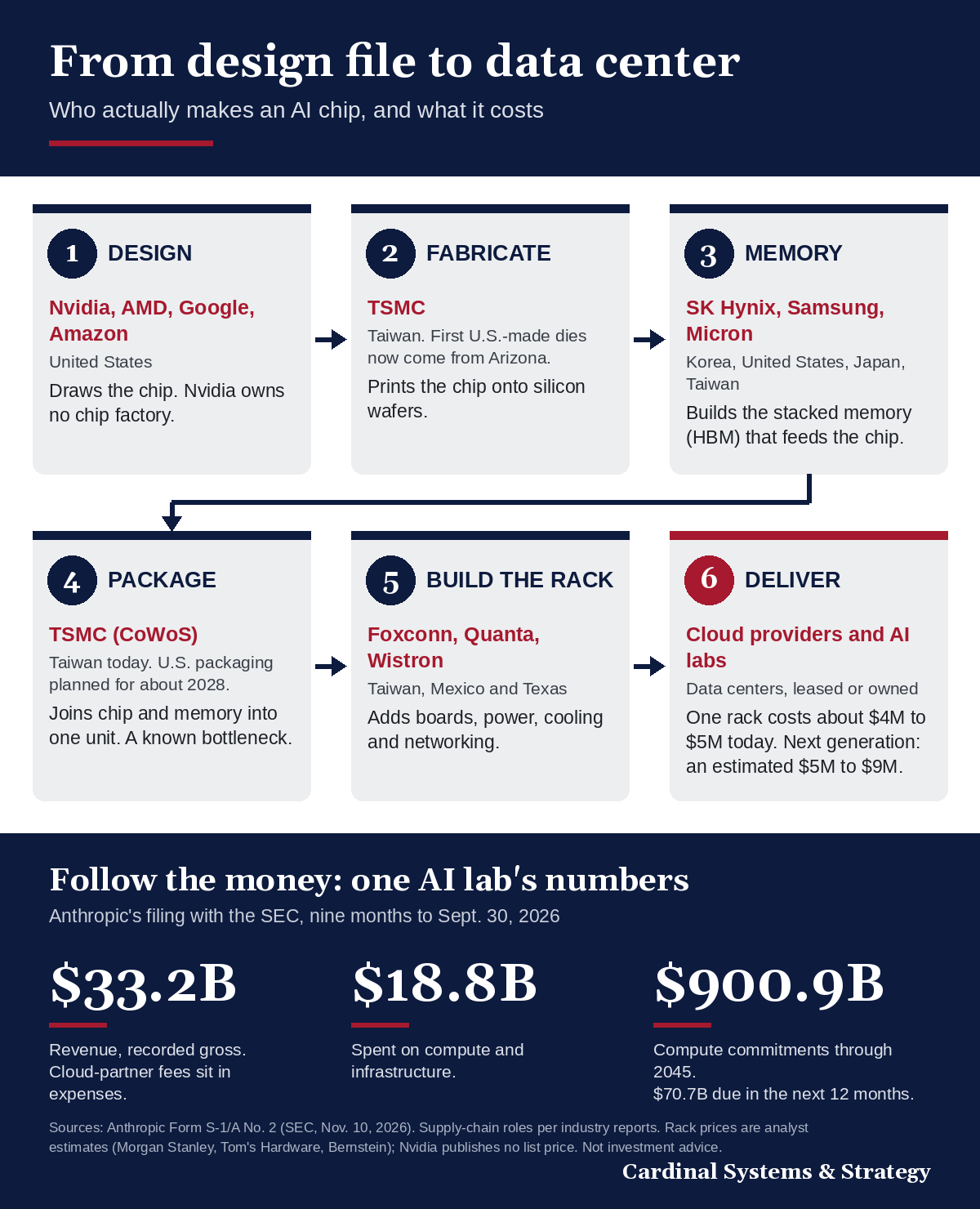
Revenue is growing fast and spending has not stopped. Anthropic reported $33.2 billion of revenue for the first nine months of 2026, and its IPO has reportedly drawn orders for about six times the shares offered. The largest spenders outlined as much as $828 billion of AI spending for 2026. Skeptics answer that growth has to outrun enormous commitments.
How much does Anthropic owe?
On its balance sheet, very little: about $6.2 billion in convertible notes, mostly Amazon’s. The larger exposure is commitments: about $900.9 billion of compute and infrastructure spending through 2045, with $70.7 billion due in the next year. Cash and short-term investments were $131.8 billion on Sept. 30. The risk is paying fixed bills if usage-based revenue slows.
What happened at Nvidia?
Founder and CEO Jensen Huang resigned on Nov. 12 after reports of extramarital relationships, including one with a woman alleged to be a Chinese spy. No criminal charges have been reported. CFO Colette Kress is interim CEO. Analysts had said losing Huang could cost Nvidia up to 20% of its market value, and the shares closed about 4% lower that day.
How does an AI chip become a rack?
Nvidia designs its chips but owns no chip factory. TSMC prints them in Taiwan, SK Hynix, Samsung and Micron supply the stacked memory, and TSMC joins chip and memory in a step called CoWoS. Foxconn, Quanta and Wistron then build the racks. A current rack costs an estimated $4 to $5 million; next-generation estimates run $5 to $9 million. Nvidia publishes no list price.
What would show it has really broken?
Watch for four things: a big spender cutting its spending plans, AI debt deals failing to find buyers, chip orders falling, and broad stock indexes dropping far more than they have so far. Until one of those appears, our read is a sharp correction and a lot of uncertainty, not a confirmed burst.
Anthropic’s IPO, with a disclosure
What about Anthropic’s IPO? Anthropic will price its IPO on Nov. 18 and begin trading as ANT on Nov. 19, offering 825 million shares at $70 to $78. That implies roughly $1.3 to $1.45 trillion counting all shares and options, or about $970 billion counting only shares outstanding (our arithmetic from the filing), down from talk as high as $2 trillion. Its last private valuation was $965 billion in May.
Disclosure: Cardinal uses Claude, made by Anthropic. Nothing here is investment advice.
Theodore’s view
Opinion, not advice. I’m not an economist. What concerns me is the combination: fixed multi-year compute bills set against usage-based revenue, a market that leans heavily on a handful of AI-linked companies, and U.S. growth that, by one estimate, leans on AI spending for about a third of its pace. That is not a prediction of a crash. It is why I watch the financing and the spending plans more closely than the headlines. What would change my mind: revenue growth that keeps outrunning the bills.
Local: Upstate hiring is tight
South Carolina’s unemployment rate fell to 4.0% in September, below the 4.2% national rate, and a record 2,573,275 people are employed, according to the state’s Department of Employment and Workforce. Pickens County sits at 3.2%, tied for third-lowest of 46 counties. For an owner, a tight labor pool means competing for hires. Put a wage into your 13-week forecast before you need the person.
Also this week: when email goes down for a day
Microsoft 365, including Outlook, Teams and SharePoint, was disrupted starting the morning of Nov. 12, and Microsoft had not published a cause when this was written. Outages like this are a reminder to have a plan B: a second way to reach customers (another email or the phone), your key contacts saved somewhere offline, and a one-line “we’re having email trouble” text ready to send. Ten minutes now beats a lost day later.
Work with us
Want to see your own slow months before they arrive? Book a free 30-minute discovery call, by phone or video, or reply to this email. We’ll look at your next quarter together.
Sources
U.S. Bureau of Labor Statistics, Consumer Price Index, October 2026 (released Nov. 10). Primary. https://www.bls.gov/news.release/cpi.nr0.htm
U.S. Bureau of Labor Statistics, Employment Situation, October 2026 (released Nov. 6). Primary. https://www.bls.gov/news.Release/empsit.htm
Federal Reserve, FOMC statement, Oct. 28, 2026. Primary. https://www.federalreserve.gov/newsevents/pressreleases/monetary20261028a.htm
IRS, Announcement 2026-11, business mileage rate of 76 cents from July 1, 2026. https://content.govdelivery.com/accounts/USIRS/bulletins/401fe16
AAA, national gas price report, Nov. 5, 2026. https://gasprices.aaa.com/?p=5262
10-year Treasury yield, Nov. 7, 2026 (24/7 Wall St.). Secondary. https://247wallst.com/cards/mortgage-rates-corporate-borrowing-costs-and-long-duration-macro-release-01m6smykmphb79mqnmpstd9she
Gold: Nation Thailand market report, Nov. 3, 2026. Secondary. https://www.nationthailand.com/business/40073078
Bloomberg, AI and the financial markets, Nov. 6, 2026. https://www.bloomberg.com/graphics/2026-ai-bubble-financial-markets/
Nasdaq and S&P 500 declines, Nov. 5, 2026 (Deutsche Welle via Tech Insider). Secondary. https://tech-insider.org/ai-sell-off-2-5-trillion-nasdaq-5-52-percent-democrats-ai-regulation-fears-2026/
ING, AI and U.S. growth (reposted by TalkMarkets). Secondary. https://talkmarkets.com/article/how-much-is-ai-contributing-to-us-economic-growth-1787193106
Epoch AI, AI data centers as a share of U.S. GDP. https://epoch.ai/data-insights/ai-datacenter-share-gdp
Anthropic, PBC, Form S-1/A No. 2 (SEC, Nov. 10, 2026). Primary. https://www.sec.gov/Archives/edgar/data/2130357/000162828026072484/anthropicpbc-sx1ax2.htm
CNBC, Anthropic sets IPO price range, Nov. 10, 2026. https://www.cnbc.com/2026/11/10/anthropic-sets-price-range-of-70-to-78-in-upcoming-ipo.html
CNBC, Jensen Huang scandal, Nov. 13, 2026. https://www.cnbc.com/2026/11/13/jensen-huang-scandal-casts-doubt-on-nvidias-ai-dominance-how-we-got-here.html
Forbes, timeline of the Nvidia scandal, Nov. 13, 2026. https://www.forbes.com/sites/alisondurkee/2026/11/13/jensen-huang-ousted-timeline-of-the-nvidia-scandal/
Al Jazeera, Nvidia and the spy allegations, Nov. 9, 2026. https://www.aljazeera.com/news/2026/11/9/why-is-nvidias-jensen-huang-at-the-centre-of-a-us-china-spy-scandal
Chip supply chain overview (Penchan). Secondary. https://penchan.co/en/market/ai/supply-chain/nvidia-supply-chain/
Rack price estimates (Spheron). Analyst estimates; Nvidia publishes no list price. https://www.spheron.network/blog/nvidia-vera-rubin-nvl72-guide/
Microsoft 365 outage live coverage, Nov. 12, 2026 (Tom’s Guide). Secondary. https://www.tomsguide.com/news/live/microsoft-outlook-down-live-updates-outage-11-12-26
Pickens County Courier, citing S.C. Department of Employment and Workforce, September 2026. Secondary. https://www.yourpickenscounty.com/county-unemployment-sees-huge-drop-in-september/
Relay, How to build a 13-week cash flow forecast. Method guide. https://relayfi.com/blog/13-week-cash-flow-forecast/
Monefy, Build a 13-week cash flow forecast. Method guide. https://www.monefy.com/article/build-13-week-cash-flow-forecast-small-business
Estimated tax due dates for 2026 (Credit Karma). Secondary. https://www.creditkarma.com/tax/library/tax-filing-basics/estimated-tax-payment-due-dates/
Issue 02 · November 2026 · The Upstate Owner’s Letter, from Cardinal Systems & Strategy.
You are reading this because you signed up at cardinalsystemsandstrategy.com. This newsletter is general information, not legal, tax or investment advice. Cardinal Systems & Strategy, LLC, 3620 Pelham Road, Ste 5-188, Greenville, SC 29615.